
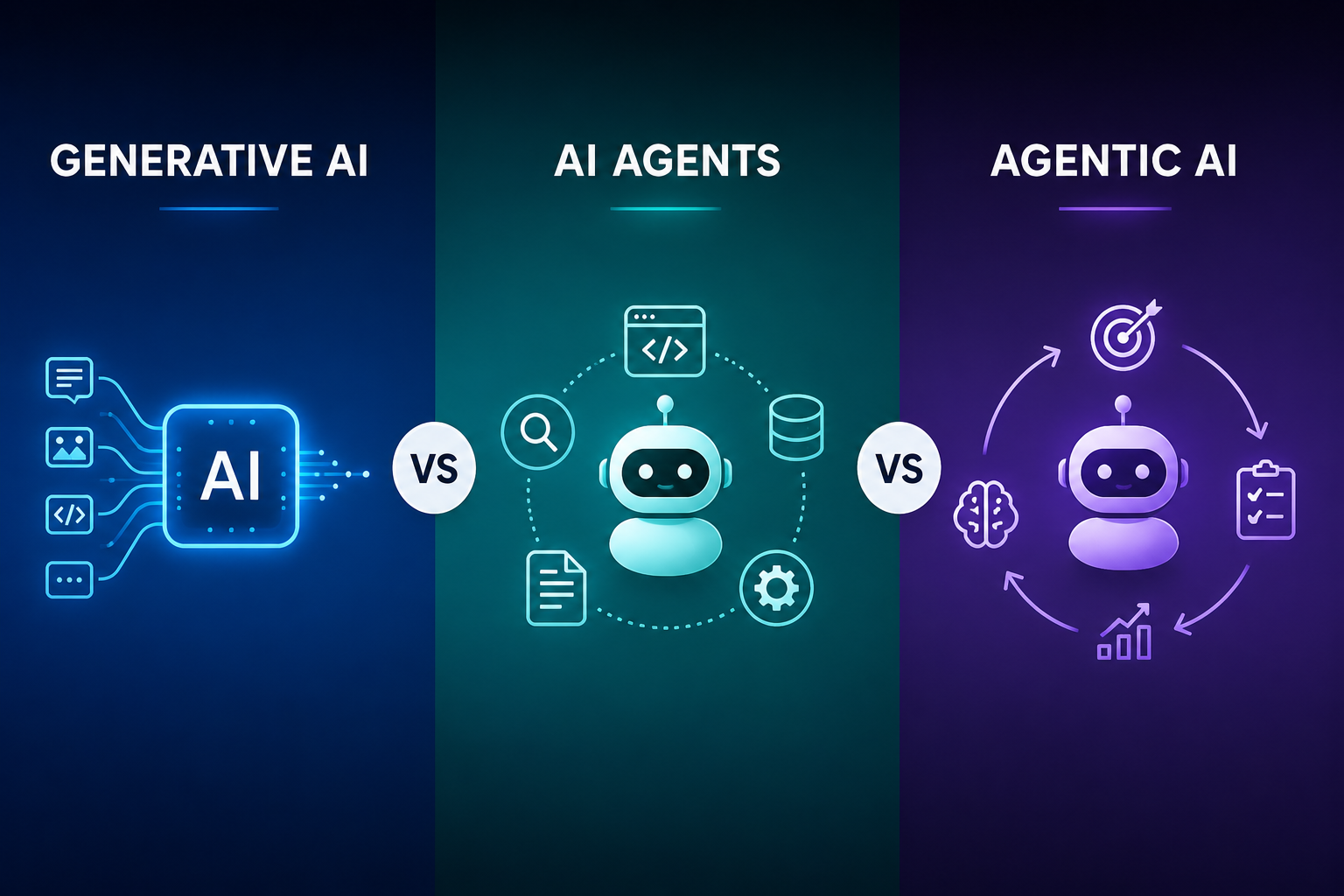
Generative AI vs AI Agents vs Agentic AI: What’s the Difference?
The world of Artificial Intelligence (AI) moves fast. Just as we all got used to writing prompts for tools like ChatGPT, new terms started popping up everywhere: AI Agents and Agentic AI.
If you are confused about how Generative AI vs AI Agents vs Agentic AI differ, you are not alone. While they sound similar, they actually represent completely different levels of tech smarts, independence, and capability.
Let’s break them down in plain English so you can see exactly how they compare.
What is Generative AI? (The Creator)
Generative AI (GenAI) is AI that can create new content. This includes writing text, generating images, making videos, or writing computer code.
How It Works
Generative AI works on a basic input-and-output model. You give it a prompt (an instruction), and it uses its underlying Large Language Model (LLM) to predict and give you the best answer.
Key Features:
- Reactive: It only works when a human prompts it.
- Low Independence: It cannot browse your apps, update your files, or make decisions on its own.
- Output Focused: It is built purely to create content or summarize info.
Example: You ask an AI to “Write a follow-up email to a client.” It writes a great email instantly. But it cannot open your email app, look up the client’s address, or send it. A human still has to do that part.
What is an AI Agent? (The Doer)
An AI Agent takes things a step further. It is a specialized AI designed to do specific, pre-set tasks by connecting an LLM to external tools and apps (like Slack, Google Drive, or databases).
If Generative AI is the brain that thinks up the words, an AI Agent is the hand that uses software to get a specific job done.
How It Works
AI Agents work within strict rules set by humans. They use “tool calling” to connect to other software, allowing them to look up real-time data or complete a set chain of tasks.
Key Features:
- Task-Oriented: Built to handle specific workflows (like customer support tickets).
- Connected to Tools: Can use APIs to talk to other apps and software.
- Limited Freedom: It works on its own, but it cannot change the plan or handle major surprises without human help.
Example: A flight-booking AI agent searches multiple travel sites, finds the cheapest flight to New York based on your budget, and presents the option. It completes a multi-step task, but it cannot re-route your whole trip if your flight gets canceled.
What is Agentic AI? (The Independent Thinker)
Agentic AI is the most advanced level of AI. Instead of just doing one task, Agentic AI systems can look at a situation, create a multi-step plan, and execute it to reach a long-term goal with very little human help.
Instead of waiting for you to tell it what to do next, Agentic AI manages entire projects by commanding a team of smaller AI Agents.
How It Works
Agentic AI runs on a continuous loop: See → Plan → Act → Learn. You give it a high-level goal, and it figures out all the smaller steps needed to achieve it, fixing its own mistakes along the way.
Key Features:
- Goal-Driven: It works proactively toward a big goal instead of waiting for daily prompts.
- Smart Decision-Making: It adapts to new information and changes its plan if something goes wrong.
- High Autonomy: It can run complex workflows across multiple systems completely on its own.
Example: Instead of just drafting a sales email, an Agentic AI system can scan your sales pipeline, notice a client needs a follow-up, gather their past data, draft a custom reply, send it, and update your records. While highly efficient, managing the operational infrastructure and enterprise AI costs of these multi-agent workflows requires careful planning.
Generative AI vs AI Agents vs Agentic AI: How They Compare
| Feature | Generative AI | AI Agents | Agentic AI |
| Main Goal | Creating content & text | Doing specific tasks | Achieving big goals |
| How it Starts | Waits for your prompt | Follows a set rule | Proactively takes action |
| Independence | Low | Medium | High |
| Capability | Single-step answers | Uses basic software tools | Manages entire workflows |
Summary: Which One Do You Need?
- Use Generative AI when you need help brainstorming, writing, or summarizing information.
- Use AI Agents when you want to automate simple, repetitive tasks that connect to other software.
- Use Agentic AI when you want to automate entire business operations from start to finish without needing to manage every step.
Frequently Asked Questions
1. What is the main difference between Generative AI vs AI Agents vs Agentic AI?
The main difference is the level of independence and action. Generative AI is a reactive tool that creates text or images based on a human prompt. An AI Agent takes things a step further by using specific software tools to complete a single, pre-set task. Agentic AI is a fully autonomous system that can look at a big goal, create its own multi-step plan, and fix its own mistakes to get the job done without human hand-holding.
2. Is ChatGPT Generative AI or an AI Agent?
Standard ChatGPT is Generative AI because it just replies to your prompts. But when you give it plugins or tools to browse the web and connect to other apps, it acts like an AI Agent.
3. What makes an AI “Agentic”?
An AI is Agentic when it doesn’t need humans to prompt it for every single step. It can make its own decisions, fix its own mistakes, and work toward a goal proactively.
4. Can AI Agents work together?
Yes. In Agentic AI systems, different agents team up like coworkers. One might gather data, another checks it for errors, and a third sends the final email.
5. Do businesses need AI Agents or Agentic AI?
It depends on the job. Use AI Agents for simple, repetitive tasks like answering basic customer emails. Use Agentic AI for huge, complex projects like managing an entire supply chain.